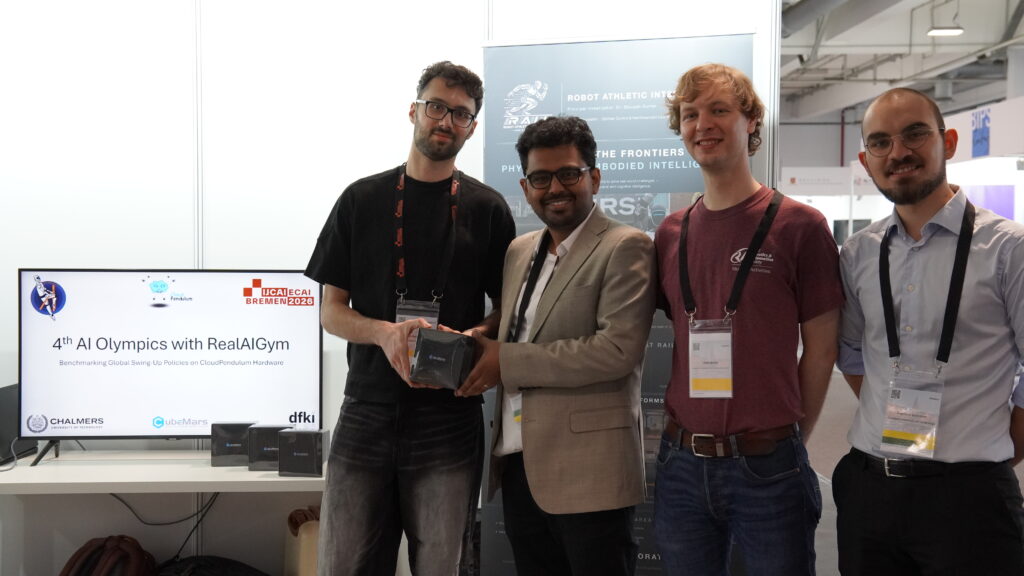
Our lab participated in the 4th AI Olympics with RealAIGym, held as part of IJCAI-ECAI 2026 in Bremen, Germany. LAR was represented by Nick Karydakis and Konstantinos Chatzilygeroudis, who competed in both the Pendubot and Acrobot tracks.
The competition brought together researchers working on robotics, reinforcement learning, and optimal control to tackle the swing-up and stabilization of underactuated two-link robotic systems on the CloudPendulum real-hardware platform. In the Pendubot configuration, the shoulder joint is actuated, while in the Acrobot configuration, the elbow joint is actuated.
For the competition, our team developed a real-time nonlinear Model Predictive Control (NMPC) approach based on Sequential Quadratic Programming (SQP). The controller performs both swing-up and stabilization within a single receding-horizon optimization framework, using structure-exploiting ADMM and interior-point methods to solve the resulting quadratic programs in real time.
Our approach achieved first place in both the Pendubot and Acrobot tracks, securing a double win for LAR at the 4th AI Olympics.
The methodology and experimental results are presented in our paper, “Real-Time Nonlinear MPC via Sequential Quadratic Programming with Structure-Exploiting ADMM and Interior-Point Methods for Underactuated Double-Pendulum Swing-Up”, available on arXiv. The source code for reproducing our experiments is also publicly available on GitHub.
The competition was organized by the DFKI Robotics Innovation Center and the Robot Athletic Intelligence Lab (RAIL) from Chalmers University of Technology. The event took place in the context of the joint IJCAI-ECAI 2026 conference, organized by IJCAI together with ECAI / EurAI.
We thank the organizers from DFKI and Chalmers University of Technology, as well as the teams behind RealAIGym and CloudPendulum, for organizing the competition and providing an exciting real-world benchmark for robotics, optimization, and control.